MonGate — Automated Gate Specialists
Call UsGet A Quote
Safety & compliance

Electric gate safety. A gate is a machine, and should be treated like one.

A set of automated gates weighs a couple of hundred kilos and moves under power near where people walk. In law that makes it machinery, not a garden accessory — and it puts real duties on whoever installs it.

Most homeowners never think about any of this, and they should not have to. It is the installer’s job. But it is worth knowing what a properly finished gate looks like, because the corners that get cut are not visible from the driveway.

On every installation

Six things, on every job, without being asked.

01

A risk assessment before anything is fitted

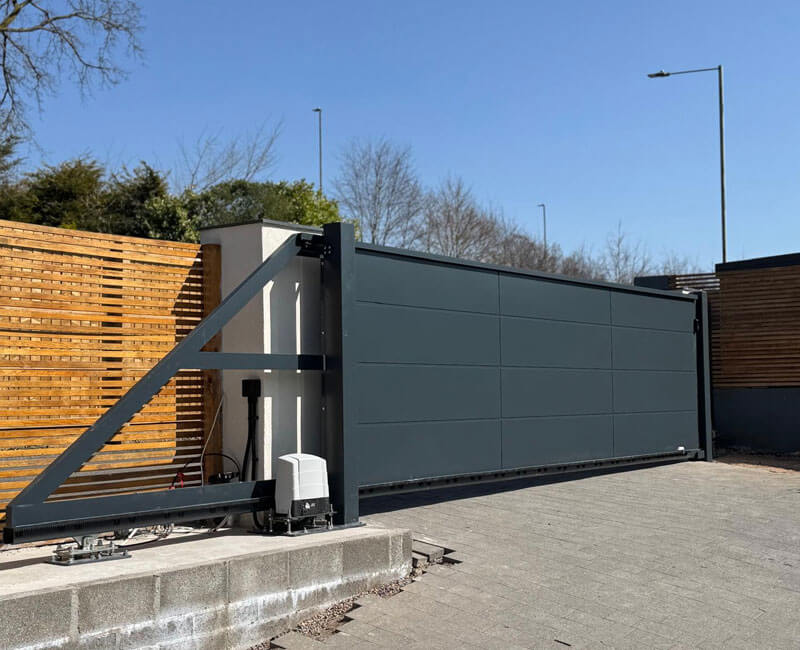
A powered gate is legally a machine, and the person who puts the finished installation together is responsible for assessing how it could hurt someone. Crushing points, shearing points, draw-in points, and what happens when a child or a delivery driver is in the wrong place at the wrong time.
02

Photocells across the opening

Beams that stop and reverse the gate the moment something crosses them. Positioned for the way your entrance is actually used, not just bolted to the nearest post.

03

Safety edges where they are needed

Pressure-sensitive edges that stop the gate on contact, on the leading edge and anywhere a gap closes as the gate moves.

04

A force test on the finished installation

The forces the gate exerts are measured and adjusted until they fall inside the permitted limits. A gate that closes hard because it "needs the push" is a gate that has not been set up properly.

05

A manual release you know how to use

Every system we fit can be released by hand, so a power cut never leaves you shut in or shut out. We show you how before we leave.

06

A handover pack

Covering safe operation, how to isolate the power, the manual release procedure and what the safety devices do. Keep it with the house paperwork.

The standards

What the rules actually say.

Plain English, and current — the standards in this area were reorganised in 2017 and a surprising number of websites have not caught up.

  • BS EN 12453:2017

    The current British Standard for the safe use of power-operated gates and doors. The 2017 revision merged the old requirements standard and the separate test-methods standard (BS EN 12445) into one document, so anyone still quoting BS EN 12445 at you is working from a withdrawn version.

  • BS EN 13241

    The product standard covering the gate itself — the performance the finished product has to meet.

  • DHF TS 011

    The Door & Hardware Federation’s technical specification for powered gates. Not law, but the Health and Safety Executive routinely points to DHF guidance as industry best practice, which makes it the yardstick if anything ever goes wrong.

  • Supply of Machinery (Safety) Regulations

    A powered gate is machinery in law. Whoever assembles the finished installation is treated as its manufacturer, with the duties that brings — assessment, safeguarding and documentation.

General guidance, not legal advice. If you are responsible for a gate used by the public or by employees, take advice specific to your site.

Already have a gate?

Six things worth checking on an older installation.

We find these regularly on gates fitted by others, and most of them are cheap to put right. None of them are worth ignoring.

No photocells at all, or photocells that have been disconnected because they were "always triggering"

A gate that closes hard enough to leave a mark, with the force turned up to mask a mechanical problem

Gaps between the moving leaf and a wall or post that close as the gate travels — a crushing point

A manual release that nobody in the house knows how to operate

No paperwork at all: no risk assessment, no handover, no record of a force test

Safety edges that have perished, been painted over, or were never fitted

Get in touch

Ask us how your gate was signed off.

Any installer should be able to tell you what safety devices are fitted, that a force test was carried out, and hand you the paperwork. If yours cannot, that is worth knowing.